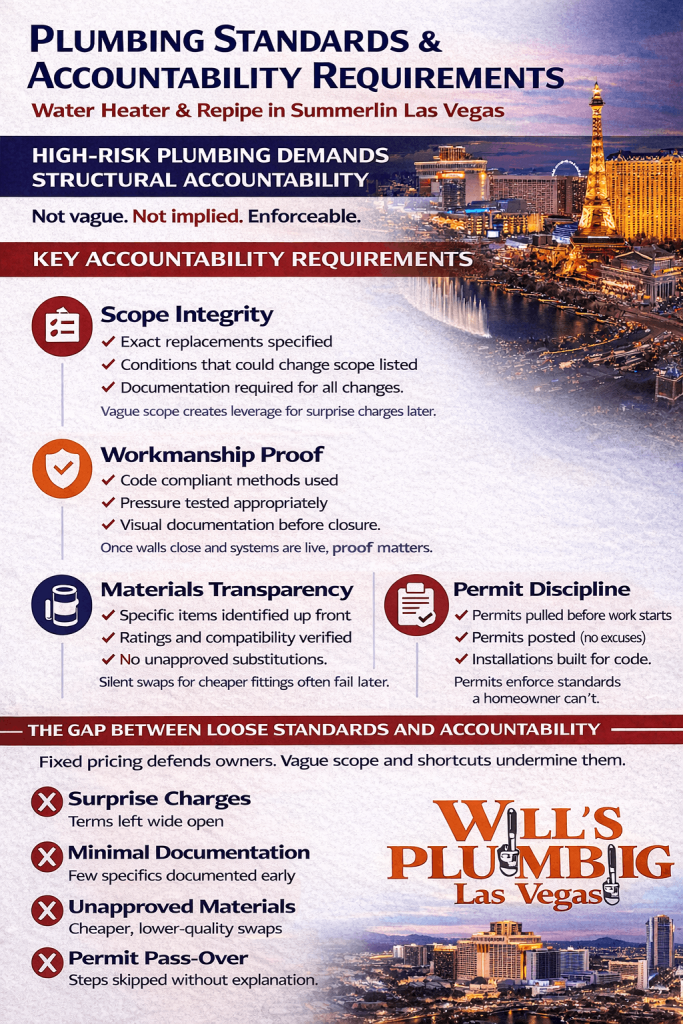
Plumbing Standards & Accountability Requirements – Water Heater & Repipe in Summerlin Las Vegas
Why Standards Matter More on Water Heaters and Repipes
Some plumbing work is inconvenient when it goes wrong.
Other work becomes expensive, destructive, and disruptive.
Water heater replacements and whole-home repipes fall into the second category. These systems operate under pressure, heat, and constant use. Failures are rarely immediate. They show up later—through leaks, corrosion, pressure loss, or property damage.
The purpose of this page is simple.
It explains what should be standard on high-risk plumbing work, and why accountability—not speed or pricing—is what protects homeowners long after installation day.
The Plumbing Standards & Accountability Requirements – Water Heater & Repipe in Summerlin Las Vegas framework exists to remove guesswork from decisions homeowners are often forced to make quickly.
The Problem Homeowners Rarely Realize
Most homeowners don’t know what proper plumbing standards look like.
Not because they’re careless. Because the industry doesn’t explain them.
As a result:
- Scope is vague
- Materials are underspecified
- Permits may or may not be pulled
- Documentation is minimal
When standards are unclear, nothing is enforced. And when nothing is enforced, responsibility becomes optional.
That gap is where most long-term plumbing problems begin.
Why Water Heaters and Repipes Carry Higher Risk
Not all plumbing jobs carry the same consequences.
Water heater work involves:
- Gas or electrical systems
- Pressure regulation
- Venting and safety controls
- Manufacturer warranty requirements
Repipes affect:
- Entire supply systems
- Wall integrity
- Pressure balance
- Long-term leak exposure
Mistakes don’t always fail immediately. They fail quietly. Months later. Sometimes years later.
Accountability is what determines whether those failures are addressed—or denied.
The Accountability Standard Applied to High-Risk Plumbing
This framework focuses on four areas that matter most on water heaters and repipes. Not best practices. Requirements.
Scope Integrity Comes First
Clear scope is not paperwork.
It is protection.
Before work begins, homeowners should understand:
- What is being replaced
- What is being reused
- What conditions could change scope
- How changes are documented
Vague language creates leverage for surprise charges later. Precise scope removes that leverage.
For emergency plumbing situations, scope clarity matters even more. Stress compresses decision-making. Standards slow it down just enough to keep control.
Workmanship Proof Is Not Optional
Once walls are closed and systems are live, proof disappears unless it is captured.
Workmanship proof includes:
- Code-compliant installation methods
- Manufacturer-specified clearances
- Pressure testing where required
- Visual documentation before closure
This matters for everything from water heater replacement to full repipes. Homeowners should never have to “trust” unseen work without verification.
Proof protects both sides. It documents responsibility.
Materials Transparency Prevents Silent Failures
Not all pipe, fittings, valves, or heaters are equal.
And substitutions are common when standards aren’t enforced.
Materials transparency means:
- Specific products are identified
- Ratings are appropriate for pressure and heat
- Compatibility is verified across the system
This is especially critical in custom home plumbing and high-end plumbing fixtures, where performance expectations are higher and failure costs more.
Silence around materials is a warning sign.
Code and Permit Discipline Is a Line, Not a Suggestion
Permits are not bureaucracy.
They are third-party verification.
For water heaters and repipes, code compliance ensures:
- Safety systems are present
- Venting is correct
- Pressure and temperature limits are enforced
- Installations meet minimum durability standards
When contractors avoid permits without explanation, accountability shifts entirely onto the homeowner. That shift is rarely disclosed upfront.
The Fears Homeowners Don’t Voice—But Should
Most homeowners worry about price.
What they should worry about is what happens later.
Common concerns include:
- “Why is there an extra charge now?”
- “Who approved this change?”
- “Is this install documented?”
- “Will this pass inspection?”
These questions usually surface after the work is done—when leverage is gone.
Standards exist to prevent those moments, not explain them away.
How Surprise Charges and Disputes Actually Start
Disputes rarely come from bad intent.
They come from unclear systems.
Surprise charges often trace back to:
- Undefined scope language
- Assumptions not documented
- Materials swapped without discussion
- Permit steps skipped
Each of these is preventable. All of them disappear when accountability standards are enforced from the beginning.

What This Standard Filters Out
This framework is not designed to appeal to everyone.
It filters out:
- Contractors who rely on ambiguity
- Jobs priced low by cutting documentation
- Installations that can’t be verified later
What remains are projects built around clarity, traceability, and responsibility.
That filtering is intentional.
How Experience Shows Without Being Claimed
Experience isn’t proven by saying “we’ve done this for decades.”
It shows up in anticipation.
Experienced plumbing operators explain:
- Why certain materials are specified
- Why permits matter on this job
- Why shortcuts cause future problems
They don’t rush explanations. They reduce future friction by addressing it upfront.
That restraint is a signal of competence.
Why Best Rated Applies These Requirements
Best Rated does not promote contractors based on claims.
It evaluates whether standards are structural and enforceable.
Water heaters and repipes are not areas where improvisation belongs. The risks are too high. The costs are too real.
That is why these accountability requirements are treated as minimums—not enhancements.
Where Wills Plumbing Fits Within This Framework
Wills Plumbing Las Vegas is a locally owned plumbing company founded in 2016 and led by owner William (“Will”) Council. While the business itself is established within the last decade, it is built on decades of hands-on plumbing experience that informs how high-risk work is approached.
Operating as a licensed plumber in Las Vegas, the company is BBB accredited with an A+ rating and serves residential and light commercial plumbing needs. Its service scope includes emergency plumbing, drain cleaning, sewer repair, leak detection, water heater repair, water heater replacement, and full or partial repipes.
Experience with custom homes and high-end plumbing fixtures places additional emphasis on documentation, materials transparency, and code discipline—areas where accountability matters most.
The Final Perspective
Water heater and repipe work is not just about restoring service.
It’s about ensuring the system remains safe, verifiable, and defensible years later.
The Plumbing Standards & Accountability Requirements – Water Heater & Repipe in Summerlin Las Vegas exist to help homeowners recognize what should already be standard—and to understand when it isn’t.
When accountability is built into the process, fewer problems survive long enough to become emergencies.